Three key systems for the platform kings under the sky,
Seven living rooms with a panel from 2016,
Nine mortal engines doomed to die,
One harness in the dark where the black screens lie.

One player to rule them all, one player to find them,
One player to bring them all, and in the darkness bind them.
Every streaming company I have worked at has the same cupboard. In it are six player integrations, one per platform family, each maintained by whoever drew the short straw, and all of them drifting apart from the day they were written. Somebody eventually proposes unifying them. Somebody else points at the 2016 televisions and the room goes quiet.
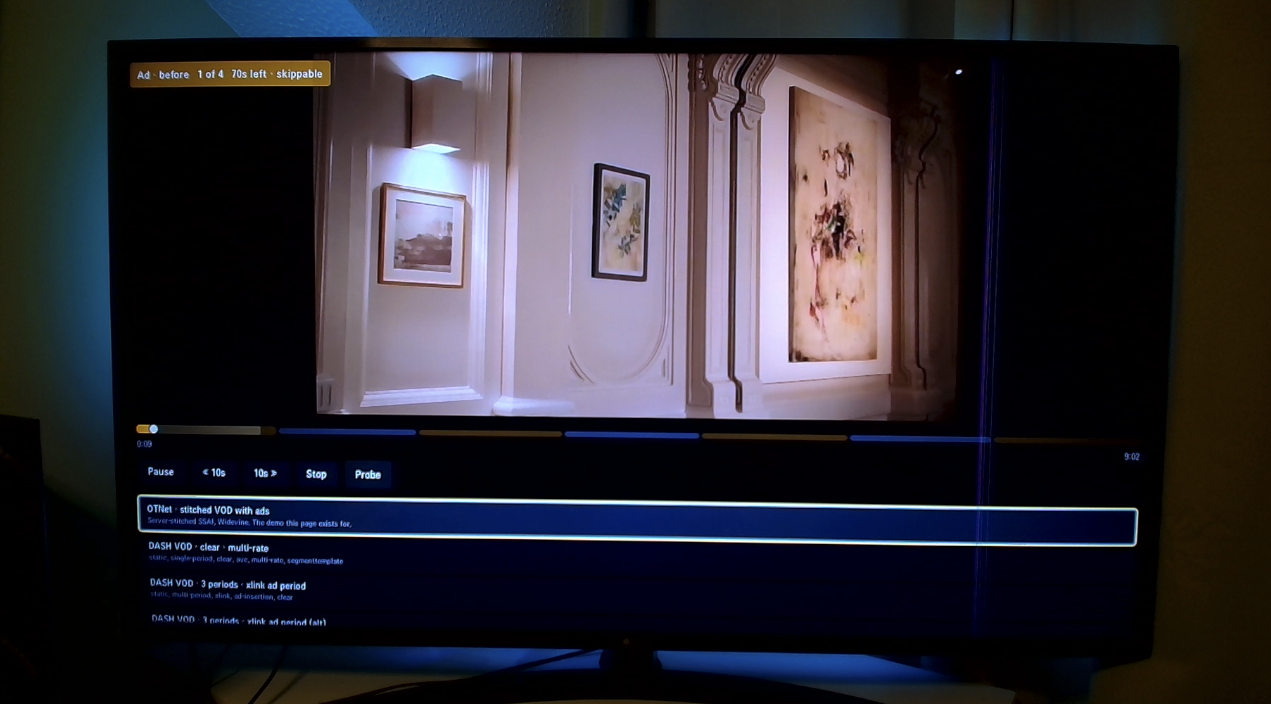
KISSPlayer is me refusing to let the room go quiet. DASH and HLS on Media Source Extensions, zero runtime dependencies, and a target list that starts at a 2016 set rather than ending at one. It now plays encrypted content with server stitched ads on exactly that hardware: Widevine licence, key exchange, decrypt, and a seven period stitch running preroll, content, midroll, content, midroll, content, postroll straight through without dropping a frame.
That is an LG in my office up there, mid preroll, decrypting. The amber blocks along the bar are the four ad breaks, drawn from the manifest before a single frame plays.
DRM and ad insertion are the two things that are supposed to require a heavyweight player, and they are precisely the two things these sets get locked out of. That is the whole wager. If those two work on the oldest panel I own, everything newer is a formality.
The fellowship
Here is every device on the list. Not a roadmap with quarters on it, just the honest inventory of what a player has to reach before anyone can claim it covers television. One box is ticked. The ticked one took a fortnight, which should tell you what the rest are worth.
TELEVISION OPERATING SYSTEMS
  [x] LG webOS                 2016 onward   Widevine, PlayReady
  [ ] Samsung Tizen            2016 onward   Widevine, PlayReady *
  [ ] Hisense VIDAA            VIDAA U2 onward
  [ ] Panasonic My Home Screen  and the newer Fire TV sets
  [ ] Philips Saphi
  [ ] Titan OS                 Philips, 2024 onward
  [ ] Vestel                   Toshiba, Bush, JVC, Hitachi, Polaroid
  [ ] Zeasn WhaleOS
  [ ] Foxxum OS
  [ ] NetRange
  [ ] Vewd OS                  formerly Opera TV
  [ ] TiVo OS
  [ ] Xumo TV
  [ ] Roku OS                  BrightScript, so a port not a build
  [ ] Android TV and Google TV
  [ ] Amazon Fire TV           Fire OS
  [ ] Amazon Fire TV Vega      the new one, not the old one
  [ ] Apple tvOS               no WebView, so AVPlayer or nothing

OPERATOR PLATFORMS
  [ ] HbbTV 1.5 and 2.0.x      most of European broadcast
  [ ] Freeview Play            UK
  [ ] Freely                   UK, the IP successor
  [ ] Sky Glass and Sky Stream Entertainment OS
  [ ] Virgin Media TV 360
  [ ] Liberty Global Horizon
  [ ] Humax, Netgem, Manhattan boxes

STICKS AND BOXES
  [ ] Roku Express, Streaming Stick, Ultra
  [ ] Fire TV Stick, Fire TV Cube
  [ ] Chromecast with Google TV
  [ ] Nvidia Shield
  [ ] Apple TV HD and 4K
  [ ] Onn, Xiaomi, Nokia Android boxes

CONSOLES
  [ ] PlayStation 4 and 5
  [ ] Xbox One, Series S, Series X

BROWSERS
  [ ] Chrome, Edge, Firefox     Windows, macOS, Linux, ChromeOS
  [ ] Safari on macOS           HLS and FairPlay

POCKETS
  [ ] iOS and iPadOS Safari
  [ ] Android Chrome and Android WebView
  [ ] Capacitor and React Native shells

EVERYWHERE ELSE
  [ ] Electron
  [ ] Meta Quest browser
  [ ] Android Automotive
  [ ] Signage players and Raspberry Pi kiosks

  [x] measured on real hardware, report committed, dated
  [ ] on the list
   *  PlayReady stops at the 2027 Samsung sets
A few of those are not builds, they are ports. Roku is BrightScript and has no MSE at all, tvOS has no WebView so it is AVPlayer or nothing, and the consoles each have their own peculiar idea of a browser. They are on the list because the contracts should still hold even where the code cannot, which is a lesson I learned putting one music app on six televisions.
And one asterisk is already ticking. Samsung is dropping PlayReady from the 2027 sets, which I only found because it was hiding under a checkbox in a submission form. Widevine Modular goes back to the 2017 Samsungs, so the thing you migrate to is already on the old hardware. That is the sort of fact a player should know on your behalf.
Where the campaign actually is
- DoneHappening now
LG webOS, Chromium 53, decrypting and playing ads
Widevine licence acquisition, seven period SSAI stitch, gap jumping, a committed and dated measurement report. The architecture and the device harness are in the repo. The library itself gets assembled from these findings next.
- NextNext
Samsung Tizen, Hisense VIDAA, Android TV, Fire TV
The rest of the sets I can physically get my hands on. Tizen is the interesting one, because PlayReady and Widevine both live there and one of them has a deadline on it.
- After thatNext
HbbTV, Freeview Play, Freely, the operator boxes
Broadcast is where the genuinely old hardware lives and where nobody can tell a viewer to go and buy a new television. If the player is worth anything, it is worth it here.
- EventuallyLater
Roku, tvOS, the consoles, the long tail
Ports rather than builds, because none of them run a browser in any sense I would defend. Same contracts, different language. The point is that the decisions are made once.
Three things the television lied about
Here is the part worth your time. The architecture is a proposal and proposals are cheap, so the rule in this repo is that nothing gets a tick until a real panel has been asked, on camera, with the answer committed and dated. Three questions came back wrong, and the wrong answers are more useful than the right ones would have been.
One: a gap you cannot cross
The stitched manifest is contiguous on paper. In the buffer it is not. The first ad ends at 78.999999 and the content starts at 79.104, which leaves a hole of 104 milliseconds sitting exactly where an ad hands over to the programme.
buffered range 0:  0.000000 -> 78.999999     (preroll-0)
buffered range 1: 79.104000 -> 171.103999    (content-0 onward)
                  ^^^^^^^^^ 104.001 ms hole
The period duration is not wrong. Each period declares the length of its audio track, which is the longer of the two and the correct choice. The video track is shorter because audio is encoded in a separate pass with no duration pinned to the video frame grid: audio lands on an AAC boundary, video truncates to the last whole frame. The same ad creative is reused for all four breaks, so the identical hole lands at all four.
How much shorter the video track is than the period that declares it
Per period, on one OTNet stitch, measured on an LG webOS set
ad
ad
ad
not an ad
ad
Shaka jumps anything under 500ms without telling anyone, so every hole here sits comfortably below the line at which a mainstream player would have mentioned it. That is why the same stream plays fine there and froze here.
Sources: KISSPlayer, platforms/docs/otnet.md
On a desktop you would never find this. On the television the playhead arrives at the bridge, looks at a hundred and four milliseconds of nothing, and declines. `readyState` drops to 1, `currentTime` stops, and nothing ever restarts it. A seek that lands inside the hole is worse, because it never completes and `seeking` stays true forever, which is why my first attempt at a fix did precisely nothing. It skipped gaps only when not seeking.
Shaka's smallGapLimit defaults to half a second. Every one of these holes is under a fifth of that, so a mainstream player steps over them in silence and nobody downstream ever learns the fault exists.
That is the useful part. Gap detection is not polish you add to a buffer controller once the interesting work is done. Without it, server side ad insertion simply does not play. And fixing the encoder would not save you either: padding the ad creatives removes four of the five holes and cannot remove the fifth, because the one in `content 2` is in the tail of the asset rather than in an ad. Every client has to survive holes of under 150 milliseconds in a stitched stream, permanently. That is a better thing to write into a contract than a packaging change.
Two: it lies about DRM, precisely
Asking `requestMediaKeySystemAccess` what a 2017 set supports is close to useless, so the harness asks a sharper question. For every key system it probes three encryption schemes: `cenc`, `cbcs`, and a deliberately invalid one. `encryptionScheme` was added to EME long after these engines shipped, and an unknown dictionary member is ignored rather than rejected. If the invalid control comes back accepted, the device is not answering the question at all, and every scheme it claims to support is noise.
The control came back accepted. So Widevine, PlayReady, FairPlay and ClearKey all report `unknowable`, and the capabilities panel prints that word rather than a `yes` it cannot stand behind. A probe that knows it is being lied to is worth more than one that is not.
This LG also reports `com.apple.fps` as supported, which is obviously false, and the reason turns out to be narrower than it looks: it is a name aliased onto a cenc CDM. Ask it with FairPlay init data, `skd` or `sinf`, and it refuses correctly. Ask it with `cenc` and it says yes to something it cannot honour. A probe has to ask in the key system's own init data type or the answer means nothing.
Three: the trap that hides a whole television
This one is my favourite, because it is the kind of bug that makes a device disappear from a support matrix without anyone noticing. webOS Widevine negotiates `persistentState: required` and rejects any configuration that forbids it, while `distinctiveIdentifier: 'not-allowed'` is perfectly fine on its own.
A capability prober that asks politely, with persistentState set to not-allowed, concludes that this television supports no key systems whatsoever. On a set that decrypts and plays Widevine perfectly well.
Somewhere out there is a catalogue that is not offered to a million LG televisions because a probe asked one question in a slightly careful way. Nothing logs it. The viewer just gets a shorter list of what they are allowed to watch and never knows why.
What the old engine actually manages
Once the gap jumping was in, it ran unattended: 2850ms to first frame, a 629 byte Widevine licence, all seven periods appended contiguously, 3086 frames decoded and none dropped, buffer held flat at about 95 seconds. `SourceBuffer.changeType` does not exist on this device at all, so a buffer reload is the only fallback when the codec configuration changes across a boundary.
It feeds a sliding window, 60 seconds ahead and 30 behind. The first version appended a flat 170 seconds and called `endOfStream`, which played the preroll and the first content period and then stopped dead with `ended` true. Indistinguishable from a crash, and duly reported as one by me, to me.
Nothing from the licence path is ever logged. Not the URL, because its query string carries the session token, not the challenge, not the licence, not a key id. Sizes and statuses only. Keep it secret, keep it safe.
Why not just use the eagles
The obvious question. Shaka and dash.js exist, they are excellent, and they would have carried this stream over the gap without comment. The answer is that they would also have carried it over in silence, and I would be writing a different post, about how the ads play fine and I have no idea why.
Every mainstream player is a decade of accumulated workarounds for exactly the three things above, and almost none of them are written down anywhere a person can find. You inherit the fix and never learn the fault. That is a fine trade right up until you are standing in front of a panel from 2016 that none of those players support any more, holding a black screen and no explanation.
The streams come from OTNet, which hands back a manifest with the ads already spliced in, so the stitching problem is a real one rather than something I invented to have something to solve. The architecture proposal and every device report are in the repo, dated, with the measurements they came from.
One box ticked, forty odd to go. If you own anything on that list and fancy pointing a camera at it, the harness is MIT and I would love the report.