I was submitting Audibase to the Samsung store this week and found this at the bottom of the form, sat under a checkbox alongside the one about test accounts. No email, no changelog entry. Just a thing you confirm you have read on your way to the Done button.
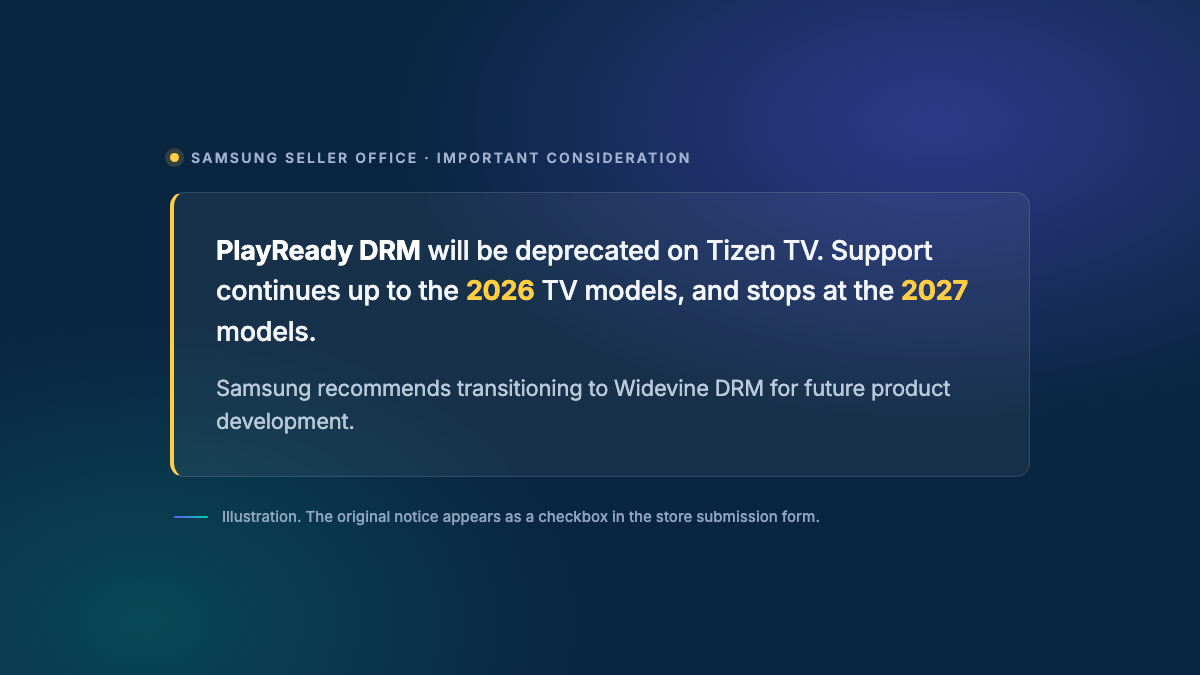
PlayReady DRM will be deprecated on Tizen TV. Support will continue up to the 2026 TV models, but it will no longer be supported starting from the 2027 TV models.
We strongly recommend transitioning to Widevine DRM for future product development.
So the 2026 sets are the last ones that play it, and they will be in living rooms for a decade. Nothing breaks on a television somebody already owns. What changes is that a set bought in 2027 will not play your PlayReady stream, and you will hear about it as a support ticket from one customer at a time rather than as a date in a calendar.
Widevine is the recommendation, and on a Tizen set that is the practical answer. The real work is not the television though. It is upstream: your packager has to emit Widevine alongside whatever it emits now, your licence server needs the second path, and your key handling has to cope with a catalogue that is encrypted one way and a player asking the other. If you package multi DRM already you are mostly reading a flag. If PlayReady is the only thing your pipeline has ever produced, this is a quarter of work, not an afternoon.
The general specifications already say it plainly: PlayReady is listed as deprecated and not recommended for new models, with v2.5 and v4.5 carried through the 2026 sets. The same table puts Widevine Modular L1 on Samsung televisions back to 2017, so the thing you are moving to is not a new device requirement. It is already on the old sets.
Worth checking that table against the oldest set you still claim to support, rather than against the newest one you own.
The part I keep thinking about is where it was. A deprecation that ends playback on an entire platform arrived as a checkbox in a submission form. If you are not shipping to that store this month, nothing tells you at all.