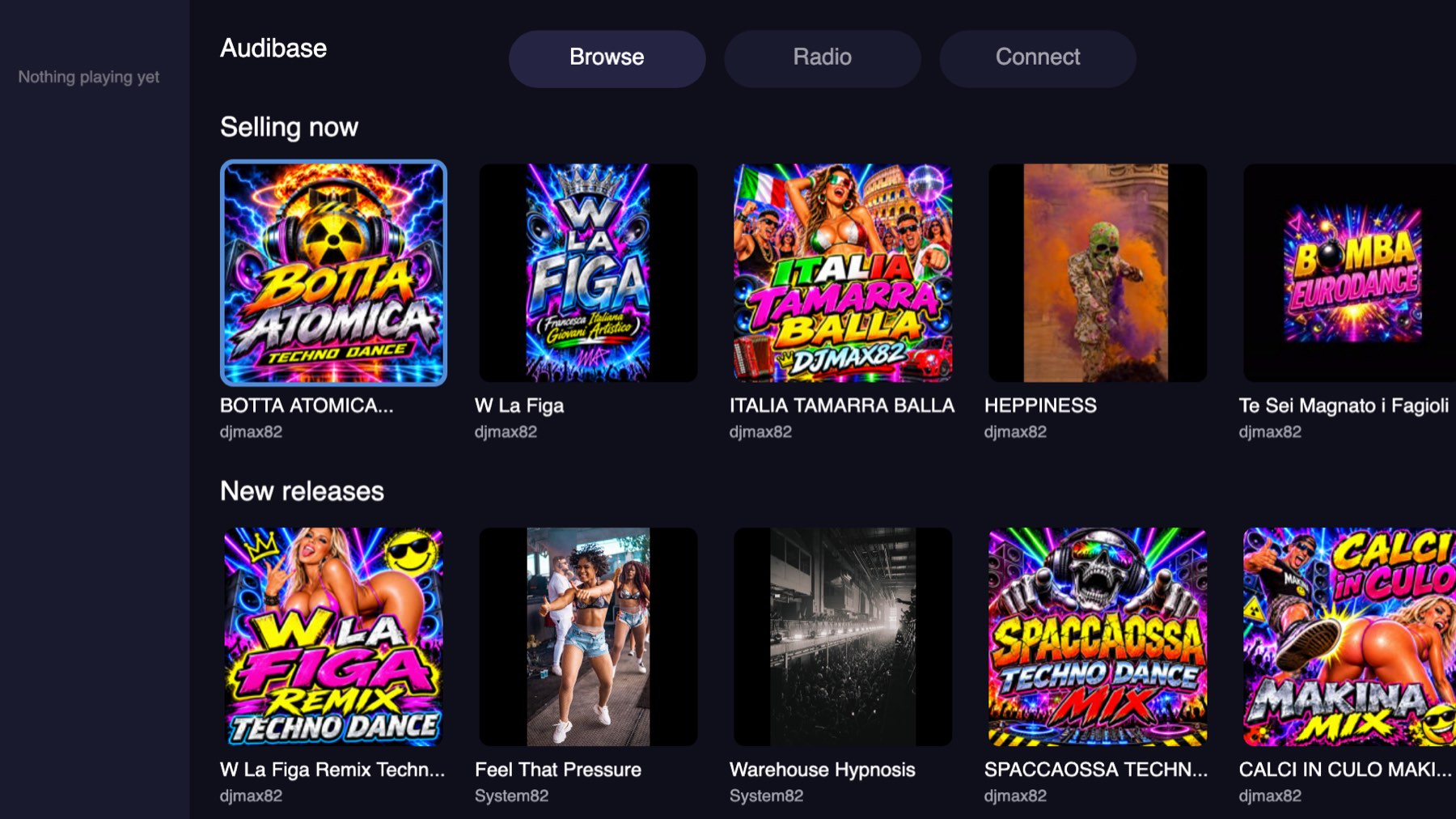
Most of yesterday went on getting Audibase running on a 2017 Samsung. Tizen 3.0, which is old enough to have its own set of problems that simply do not exist on anything current.
The app itself is not complicated to use. Browse music, pick a track, play it. Getting it to do that on this particular television was another matter.
The television lies about what it is
First symptom: no artwork. Everything else drew, audio played, and every tile was empty.
It came down to the user agent. The set identifies itself as Safari, my toolchain believed it, and Babel transpiled the bundle for a browser that was not the one actually running. A path through `URLSearchParams` and a `createImageBitmap` probe never resolved. Nothing threw. The app carried on quite happily with no pictures in it.
There are no useful errors on the television, and debugging a browser engine from 2017 is not a pleasant afternoon.
I found it in the end, fixed the compatibility, and the thing ran on real hardware. Artwork loaded, audio played, the remote moved focus where it should. Done, I thought.
Then I went to submit it
Samsung's TV Seller Office only offers model groups from 2022 onwards.
Not because the older sets cannot run the app. I had just spent a day proving that they can. The store simply gives you no way to select them for distribution.
The documentation still covers developing for older Tizen versions. The tooling still builds, installs and runs on them. Samsung even publishes a TV model groups table going back to 2012, whose stated purpose is finding the model group for a lineup when you submit to Seller Office. The 2017 sets are in it. They are `17TV` groups, documented, mapped, and not in the dropdown.
Being able to develop for a device and being allowed to distribute to it turn out to be two different questions, and only one of them is answered in the docs. The general specifications run back to 2015 and Tizen 2.3. The store starts at 2022.
So there is now a working Audibase on a 2017 Samsung in my office that nobody else with that television can install.
The lesson, which I should have known
I have worked on smart TV platforms for years, so differences between manufacturers, operating systems and browser engines are the normal shape of the job. Usually the hard part is making something work everywhere. This time the technical problem was solvable and the distribution problem was not.
You can spend a day on old JavaScript engines, missing APIs, media playback quirks and remote control behaviour, and none of it counts if the platform will not publish to the hardware you just supported.
Check your distribution constraints before your compatibility constraints.
There is not much point making an app work on a television if the people who own that television cannot install it. At least the 2017 set in the corner runs it perfectly. I may be the only person who ever sees that build.